Call Us
0086-592-6510772Email Us
sunny@qqsmould.com

Call Us
0086-592-6510772Email Us
sunny@qqsmould.com
A small parameter adjustment can solve one defect while creating another. This is why process control matters in injection molding.
In injection molding, production problems don't always come from a bad mold, incorrect material, or machine failure.
Sometimes, the problem starts with a simple parameter adjustment.
A customer once brought us a project that had experienced repeated dimensional problems at another supplier.
The mold was qualified.
The material was correct.
The machine was the same.
Yet Batch #1 was within specification, while Batch #3, produced two days later with the same mold and machine, showed critical dimensional drift.
When we reviewed the production history, the reason became clear.
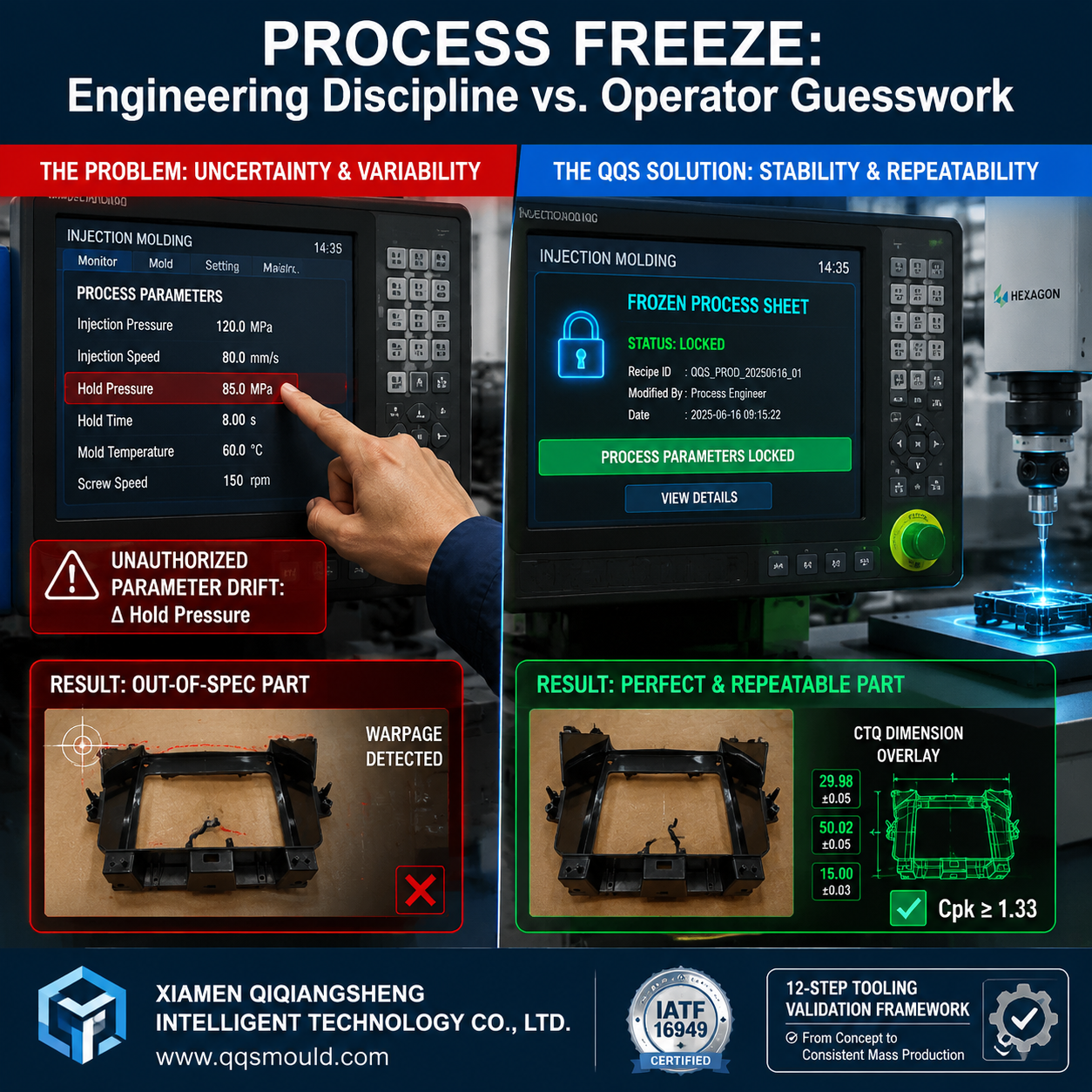
During a night shift, an operator noticed a small amount of flash on a non-critical rib. To solve it, he manually reduced the holding pressure.
The flash disappeared.
But the lower holding pressure also changed the packing behavior of the part, causing a critical snap-fit dimension to shrink out of tolerance.
The operator was simply trying to solve an immediate problem.
The real issue was uncontrolled parameter modification.
Injection molding parameters are closely connected.
Changes to:
Injection speed
Holding pressure
Holding time
Barrel temperature
Mold temperature
Cooling time
can affect:
Shrinkage
Warpage
Part weight
Dimensional accuracy
Internal stress
Surface appearance
So when a defect disappears after changing a parameter, it doesn't necessarily mean the root cause has been fixed.
One problem may simply have been exchanged for another.
At QQS, once a mold has completed T1/T2 trials, process optimization and validation, the approved process parameters become the production baseline.
Critical parameters are documented and controlled.
Operators are not expected to change them simply to solve an isolated production defect.
Instead, we first ask:
What has changed?
We check the actual production inputs:
Material:
Has the resin lot changed? Is moisture content under control?
Mold:
Is cooling working properly? Is there contamination or wear?
Machine:
Is the check ring, nozzle or temperature control functioning correctly?
Process:
Has cycle time, cooling time or another production condition changed?
Only after identifying the root cause should a process adjustment be considered.
Sometimes a process change is genuinely required—for example, because of a material variation or an approved engineering change.
In that case, the adjustment should be:
Evaluated → Tested → Approved → Documented
rather than simply changed by an operator during production.
This creates traceability and protects the validated process.
For overseas OEM customers, production consistency is more important than simply receiving a good sample.
They need to know that:
Day 100 can still match Day 1.
That's why process control, parameter management and process capability evaluation are important parts of stable injection molding.
At QQS, we believe that quality should not depend on who happens to be operating the machine on a particular shift.
Predictability isn't luck. It's process discipline.
When a part begins to drift during mass production, do you adjust the machine immediately—or investigate the root cause first?
We'd be interested to hear how other injection molding teams manage this challenge.